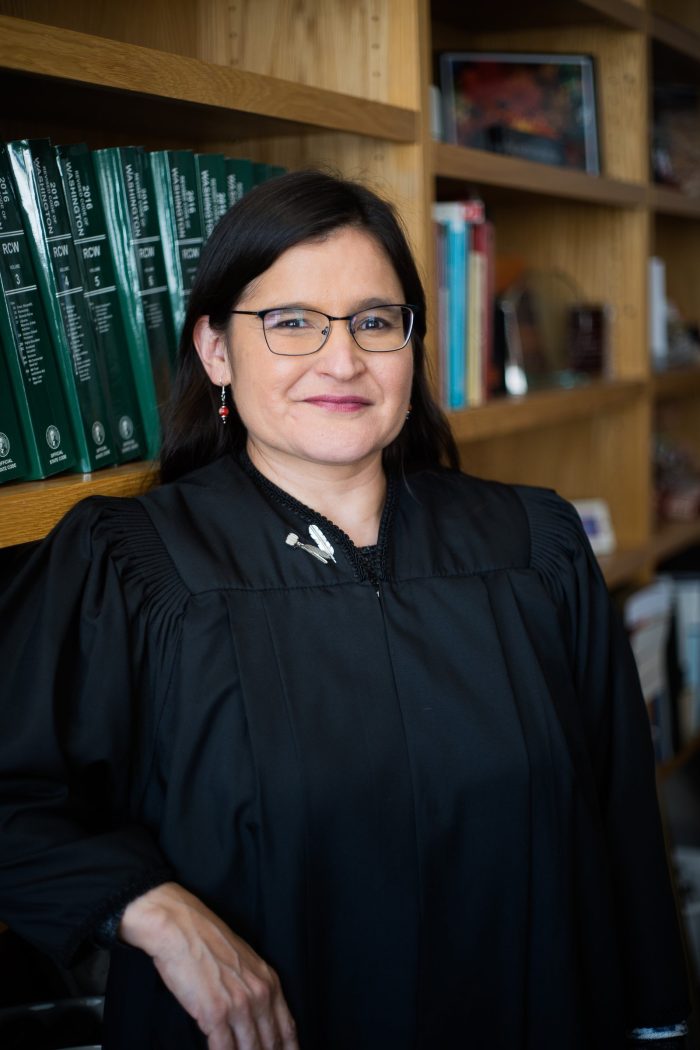
The following contains remarks by Justice Montoya-Lewis at the Washington State Supreme Court Minority and Justice Symposium: Introduction to the Film “Sugarcane.”
Condensed and Edited for Publication
Good morning, everyone and I want to thank all of the young people who are here today who opened this day in a really good way and felt very true to who we are as a people. To be in this room, with as many Native faces as I see when I was sitting up there, is incredibly moving to me. As I said, on the day that I was sworn in as Justice, one of the first thoughts I had walking up the steps of this building was, “These walls, these stairs, none of this was built with someone like me in mind.” I still think about that on a daily basis, and I’ve been thinking about that a lot recently as we’ve put together this historic day.
I want to thank everyone for their support in putting this together, the Minority and Justice Commission, and the Court. I have a brief introduction to the film after I’ve had an opportunity to share a little bit about my own family history and some of the impacts that Secretary Holland talked about that have impacted every Native person in this room, and every Native person you’ve ever met, and certainly any indigenous person in this Country and in Canada.
So, you may have all have noticed that I’m not wearing traditional lawyer clothes or judge clothes, but I am wearing traditional Pueblo clothes. But I want to tell you a little bit about what I am wearing and why it was important to me to wear this to speak to all of you today. Because this is who I really am. You know, I’ve been asked repeatedly at events like this to show up as myself, to be my authentic self. I will never forget hearing a Navajo woman speaking about that same request and finding that who she really was wasn’t welcome at work. And she said, “I leave my front door, and I leave who I truly am behind me. I always wonder, why don’t you want that part of me? Why don’t you really want who I am to be a part of the workplace and the other places that I go? Why is it necessary for me to strip that behind me in order to be successful in the mainstream world, in a mainstream way?” That really hit me when I heard her say that many, many years ago. I’ve never forgotten about it, and I think about it almost every day, because as Native people it’s very hard to show up as who we are. Particularly when who we are has been taken from us by the Federal Government, by state governments, and by courts repeatedly, unceremoniously, and under color of law.
I’ve spent many, many hours talking with some of the Justices here, and certainly with Judge Galvan about, is this the right place for someone like me to be? Is this the place where I can be the most effective and serve the ancestors who came before me? So, what I’m wearing today, this necklace here is called a squash blossom. There are many different kinds of them, and we consider them to be living beings. Some of you are aware, my mother passed away about a month ago, and my father about 20 years ago. As a result, I inherited his regalia. This is the first time I have worn any of his regalia, including this squash blossom. This coral necklace – as you might imagine, there’s not a lot of coral in New Mexico – but this comes from trading routes with communities that had coral to trade and to trade with those of us from Laguna, Isleta, and the other 17 Pueblos in New Mexico. We always have multiples of the coral and it’s the symbol of blood, of life that runs through all of us.
You may have noticed that I put this shawl on before I step down to speak, and I’m covering myself with a shawl that was made for my great, great aunt, one of whom I’ll share a little. I think I have a picture of her in this presentation. So, as I begin to speak about this painful history, I just will invite my ancestors into this room, and into this space, and to stand behind me today. And be a part of everything, that all the Native people who are incredibly brave, to be willing to come and share this. Not just with the nine Justices, but really on a national stage. As far as Justice Yu and I could find, there has never been something like this representing Indigenous humanity.
Some of you may be familiar with some of the Indian boarding school history. This slide, I encourage you to go look for it; a slide put together by the National Boarding School Healing Coalition that shows how many boarding schools have been documented so far. In the United States, this does not include Canada, they’ve been able to document 526 Indian residential schools. Many of them were run by churches. Many were run by the Federal Government. There is a tremendous amount of information at that site, if you choose to look at it. I’m going to talk very briefly about the Indian Reorganization Act for a couple of reasons. The IRA was drafted and brought to Congress by John Collier, who was the Bureau of Indian Affairs Superintendent, holding a position that was responsible for everything the Bureau of India Affairs was doing to tribes at that time. At this stage of Indigenous history with the United States, the Federal Government had sort of realized, the boarding school process of attempting to assimilate Native people into the mainstream world by “killing the Indian inside them and saving the man.” And that’s a direct quote. They decided that maybe they should start to recognize tribal governments and encourage them to have constitutions that looked similar to the constitution that we have as states, or that we have as the US Constitution.
It banned traditional religious practices. If you were to adopt an IRA constitution, you were as a tribe, theoretically agreeing to stop engaging in any religious practices. I come from a Tribe that has both a very strong Catholic community, as well as a very strong Indigenous religion. And there are stories, more than one, as recent as the 70’s, where the priest was ceremoniously marched off our reservation, and left on the freeway, after he attempted to stop our traditional religious practices. There’s a Life Magazine article about one of those that personally, I find hilarious. But, you know, it’s a very serious thing that the Federal Government would say we’re organized around an idea of freedom of religion except for you, except for those things that scare us.
John Collier was the head of the Bureau of Indian Affairs, and you may recognize the other person who was part of drafting the Indian Bureau Organization Act, and that name is Felix Cohen. A very well-respected professor of Indian Law who taught at the University of Washington Law School and someone I met when I was in law school. And he’s really considered a champion of Indian Law and a champion of Indigenous people. But this is where he started. This is language that comes from the speech by John Collier to Congress, explaining why there should be an Indian Reorganization Act that allowed tribes to create governments with constitutions similar to the US Constitution.
And I’m just going to read it to you because I think the language is really important to hear, especially in this room, dedicated to the law. “Dead is the centuries old notion that the sooner we eliminated this doomed race, preferably humanely, the better. No longer can we, even with the most generous intentions, pour millions of dollars and vast reservoirs of energy, sympathy and effort into any unproductive attempts at some single, artificial permanent solution of the Indian problem. No longer can we naively talk or think of the “Indian Problem.” Our task is to help Indians meet the myriad of complex, interrelated, mutually dependent situations which develop among them according to the very best light we can get on those happenings – much as we deal with our own perplexities and opportunities.” This is just a piece of a much longer statement by John Collier introducing the idea of having an Indian Reorganization Act in 1938.
Prior to that, and really up until today, there are still existing boarding schools in the United States. But one of the most famous was Carlisle Boarding School. And this is part of a process that Secretary Collier was referring to as having failed. This process of taking children, some as young as five, some as old as 15, from their homes and their homelands to Carlisle Boarding School, or any number of the 500 plus other boarding schools that existed in North America. The idea was born from Colonel Richard Pratt out of an idea that if we “kill the Indian” by civilizing him in an education system that teaches English, that teach him Christianity, that teaches the boys to be soldiers, the girls to be housekeepers and homemakers, and if we cut their hair and otherwise make them look the same as people in mainstream culture, they’ll lose their connections to the tribal community and see that our way is better. This first attempt, in this picture, is just a random picture I chose from the Carlisle Boarding School archive. It shows hundreds of little kids who were at this boarding school. This is an image of what we call a “before picture” and there are many, many of these. The Carlisle Boarding School, like many boarding schools, was very good at tracking the “progress” – I suppose, is the word that I should use – of the Native children who arrived. They took pictures on the day, or the day after, they arrived at Carlisle Boarding School, and they took after pictures. So that when people left, they were documented as well. This is a photograph at the bottom that says Pueblos Entered Carlisle July 1880.
We haven’t been able to figure out exactly who everyone is, but the middle, the woman in the middle at the top is my great-grandmother, Mary Perry, or known by her Laguna name of Kiyotse. She was taken from Laguna with many other children, literally placed on a train, no idea where she was going. Many of the children’s parents weren’t told where they were going, they were just told, “you can put your kid on the train, or we can do it by force.” All of us who have children, been around children can just imagine how terrifying that would be to a child, as well as to a parent, but think about it happening to an entire community. All the children are gone. What does that do to the people left behind? What does that do to the children who have to go?
So, I can tell you a little bit about what happens. This is another “before picture” of Mary Perry. She was at Carlisle for somewhere between three and six years. They have very good records, but in this instance it’s a little unclear. The other two people are also from Laguna. And one in the middle is Ben Thomas, the one at the bottom is John Chavez. Again, this is a “before picture,” and if you’ll notice, she’s wearing something very similar to what I am wearing. In today’s world, this is something I wear on important days. I wore something similar to this on the day that I got married. If I go to events, and I’m brave enough, I will wear my traditional regalia. But this is something that was pretty much daily wear in those days.
If we go onto the next one [slide]. These are some of Colonel Pratt’s own words about the young people he had in his charge. “It is a great mistake to think that the Indian is born an inevitable savage. He’s born a blank, like all the rest of us, left in the surroundings of savagery, (meaning left at home), he grows to possess a savage language, superstition, and life. When we allow him the freedom of association and the developing influences of social contact, then the Indian will quickly demonstrate that he can be truly civilized, and he himself will solve the question of what to do with the Indian.” I’ve read that quote hundreds of times, and every time I see something new in it, and whether Pratt himself would have seen what I see, is a question I suppose.
But one of the things, in preparing for today, I was thinking about given where I quite literally sit in this room. I was thinking about what it means to be truly civilized. What I’ve kind of come up with in thinking about what that means to me is the lessons my father taught me on how to shake hands. Because it’s not a tribal thing to shake hands, at least not from my tribe. And it is certainly not a tribal thing to shake hands in a firm way that my father made me practice, before I started off into the world. Being truly civilized means speaking English. If I only spoke the Tiwa and Keresan languages, I couldn’t do this job because I didn’t have the English language. But it’s not just English, right? It’s English of a certain type. And I was given the tool of being able to speak English of a certain type. Educated English, College English, Law School English, all throughout my life, I have been learning how to speak English in a way that allows me to walk in rooms like this.
I learned from my dad who was a career engineer in the U.S. Air Force and, I didn’t know until he passed, an Intelligence Officer throughout his career. But he learned by going into the Air Force what that professional look is. But there’s about six years into his career, a performance review, that talks about him not really being one of the boys. That talks about him being more difficult to work with, having ideas that are sort of outside of the box, which in today’s world maybe is something we would welcome, but it wasn’t something that’s particularly welcome in the military. When I looked at that, I saw my father in it and I saw a form of resistance there, a form of him trying to maintain who he was, even through the generations of attempts to remove who he was. That performance evaluation prevented him in the Air Force from moving up. He spent 25 years in the Air Force on track to probably become a Colonel in the Air force, which was what his goal had been. But once he got to that point where, you know, very few people get to in the US Air Force, that performance review prevented that promotion from happening. He was told that repeatedly – “Everything else is stellar – everybody thinks you’re great, we would love to keep you here and recognize the work that you’ve done, but instead we’re going to tell you that you need to retire because you are not going to advance any further.” My father was in his mid-40s when he was told that, and it was probably the biggest professional loss of his life. He never really recovered from that, in part, although he didn’t talk to me about it much as I was growing up. In part, what he felt about that was shame; he had tried so hard to fit in and that something that happened in the earlier part of his career would prevent him from continuing a career that he very much loved. As a result of that, and many other things, he became very determined that not happen to me. That I not be stopped by something like that. He didn’t use the word racism about that performance review, and I only knew about it because I eavesdropped on their conversations. I overheard them talking about, you know, this was a performance evaluation that was entirely about who he was as a person. And the part of him, he did not leave at home, that he should have left at home is the thing that got him into trouble and continued to give him problems through the rest of his military career.
So, when I see this language from the 1890s, it doesn’t just live in the 1890s, lives in me. Because I know what he meant, what Colonel Pratt meant, when he said they can be truly civilized. He meant they can look like us, talk like us, create like us, eat like us, pray like us and not like themselves. And that would be success because that would mean that the Indian would be fully assimilated into mainstream culture and then there’d be no more Indian problem. So going back to my own family story, this is my great grandmother the same person in the in the “prior pictures.” One of my children said to me when in seeing this presentation, “why do you call her Mary Perry instead of her Laguna name of Kiyotse?” And the reason is because that’s the name she used. She came in as Kiyotse, she left as Mary Perry.
She was one of the lucky people in Carlisle because she was able to return to Laguna. She returned to Laguna, in her late teens, and what she hoped to do upon her return was to bring the ideas that she learned at Carlisle and spread them throughout Laguna and New Mexico. When she returned to Laguna, she married William Paisano, and they had many children. Mary Perry, as I said, was one of the lucky ones to survive, as were the other two boys in that picture. They all went home to Laguna. But at Carlisle, and throughout all the residential boarding schools, not everyone survived. Many people didn’t make it. My Great Aunt, Mae Paisano, who arrived at Carlisle in 1884, died there six years later. We think she died of the flu, but we’re not sure. She is buried at Carlisle Boarding School, which was something that I learned in the last six months. One of things that’s happening at Carlisle is attempts to repatriate the bodies of young people who didn’t survive Carlisle. That is an ongoing and extremely technical, difficult, emotional process and one that I didn’t realize my family was involved in until I started doing some of this research and stumbled on the fact that one of my family members is still there.
Great-grandmother Mary Perry married William Paisano and they had eight children. I love this picture of my great-grandfather. Most of my elders in my life have pretty much scared me to death and this picture hangs in our bedroom. It terrifies me every time I see it. We have a whole bunch of pictures of ancestors, but it’s his staring into my soul, and in a disapproving way, I think. But I want you to notice that he is wearing the American flag. The commitment to serving in the armed forces, in tribal communities goes back many generations. My father was not an outlier. Native people have the highest rate of any demographics serving in the armed forces. And what that tells me also is my father’s career in the Air Force was also something his community really supported and was very proud of. If you ever attend any tribal event, any kind of powwow, you will see the American Flag brought out with a color guard, as well as tribal flags, and veterans honored in a special way at each event. When I see my great-grandfather wearing this flag, and when I look at this picture, I always think of him as saying, “It’s OK to say that you are an American.” What my father would add to that is that we are Indigenous Americans. We were here first, but that doesn’t change the fact that we’re loyal to the country, even the country that has attempted to destroy us.
That kind of resilience is something, a lesson that I have brought with me throughout not just my career, but it was a lesson I was taught in elementary school. My father really didn’t have much patience for my frustration with math. He knew if I learned math, I could continue in school and the way he learned math was by being beaten. Because he was learning math in English, and he was translating the numbers into the Tiwa language. As a result of that, he would be physically assaulted by the nuns. So, any complaints I had about my math teacher were sort of brushed aside because, as my dad would say, we come from people who survived.
Mary Perry and William Paisano both survived the Carlisle Boarding School and had eight children. This is my grandmother, Mae Paisano, she is one of those eight children. She was sent voluntarily by Mary and William to Haskell Indian School, which was a boarding school similar to Carlisle, but not in Pennsylvania. It was closer to home in the Midwest. The picture on the top is her graduation picture. She was trained as a teacher. When I talk about my grandparents’ education and becoming teachers, I really see this sort of full circle where my ancestors were brought to the boarding schools against the will of the community, against the will of parents, and, over the course of a single generation, that spirit sort of broke. The belief of why it would be so important to be raised at home, to learn your languages and your religion, your traditions, and the way of life that we learn from our elders was less important than getting an education. So, my great-grandparents sent all their children to boarding schools, and at least as far as I can tell, all of them graduated. I really think of my grandmother as the picture below on a horse. She was always on horse; I don’t really think of her with permed hair and a pearl necklace. I just think… I can imagine her being dressed for that photograph and, you know, tearing everything off so she could run outside and play in the fields.
We go to a very short video taken in 1898, outside the Isleta Indian School. Some of the tribes tried to keep their children home by agreeing to educate them in what were called day schools. They were often run by the church. The teachers were white, they were also treated similarly, if they spoke English, and that little loop is taken at Isleta.
I find it to be such a remarkable, I guess it’s kind of an early GIF, because it is on a loop. But just seeing all these kids in these uniforms, one of the things I really notice is that the older boys have short hair, and the girls look like they have their hair cut. I watched this video, and I think it didn’t just happen in residential boarding schools. It happened at home, it happened, you can visit where this building is, it happened there as well. So, the process of trying to deal with the Indian problem and get us to assimilate – it was one that happened in our communities and outside of our communities.
So, I’m just going to use the last couple of minutes of my time to share a little bit more about what the consequences of that story have been for my family and the generations behind me as well. I was very good at school; I was terrified of authority. It took me a long time to realize that what happened when my dad spoke to me in the Tiwa or Keresan languages, and would break down, was a result of untreated post-traumatic stress. So, his ability to communicate the language to me, to teach me the language was a direct result of what happened to him in a variety of the boarding schools that he went to. He went to three different ones. And so, the consequence of his pain, around not being able to teach me the Tiwa and Keresan languages, and before he started school, he spoke three indigenous languages and Spanish. And he left his education speaking one Indigenous language, in his mind, poorly, and English. The consequence of that has been that I speak English, and I don’t speak Tiwa. When I served as a tribal court judge for my own tribe, I often had an interpreter for me because the court took place in the Tiwa language, and I didn’t speak it. So, every court session when that was happening would begin with someone, one of the parties, typically an elder, typically a man, lecturing me on why I should not be seated where I was seated because I did not speak the Tiwa language and because I was a woman. But I should be able to speak Tiwa if I was going to run the courtroom in that community, and I would always get that lecture, and then we would move on to whatever the case was. And so, in many respects, when I think about the process of residential schooling and what started with my great grandparents and where I am now – is that it was sort of a success. It stripped me of my right to my indigenous languages. It made me question who I am for decades. It put me in a position to be a Tribal Court Judge that then got sideways with my own tribal government which disenrolled me. And I was not enrolled in my tribe for several years because of my refusal to have any ex-parte contact with the tribal council that was being sued. I understood those rules and I applied those rules and thought those rules would protect me. And what I learned was they protected me in the sense that I could say I was a good lawyer and a good judge. But it always raised the question from me, am I a good Indian? The fact that I live with that question is a direct result of the attempt to assimilate and “kill the Indian and save the man.”
As you watch this film, Sugarcane, which talks about the residential school system in Canada, please think about the fact that you know someone that history has touched, and that there are other people in this room who know that history, and for whom that history is very present. It is a gift any time someone shares with you the trauma that they experienced having a government try to strip them of who they are. So, I ask, when you’re watching this film, you receive it as a gift from the filmmakers and the participants. I invite you to watch this film with humility, thinking about what this would feel like, for your own children, your parents, your own communities, and what it would mean for you to not have access to the language that is your birthright. I want you to think about that as you hear from individual Native people who are willing to share their stories with you. Sharing our stories is the only way we know how to communicate who we are. But it takes something from us every time we do it. It’s painful, it’s hard, and we never know where those stories are going to go, and how they’re going to get retold, and whether they are retold in the way that we told them. So, listen carefully, be grateful, and know that – speaking for the tribal people here – we are in gratitude for the Court spending the day thinking about these issues and how we can be better — Thank you.