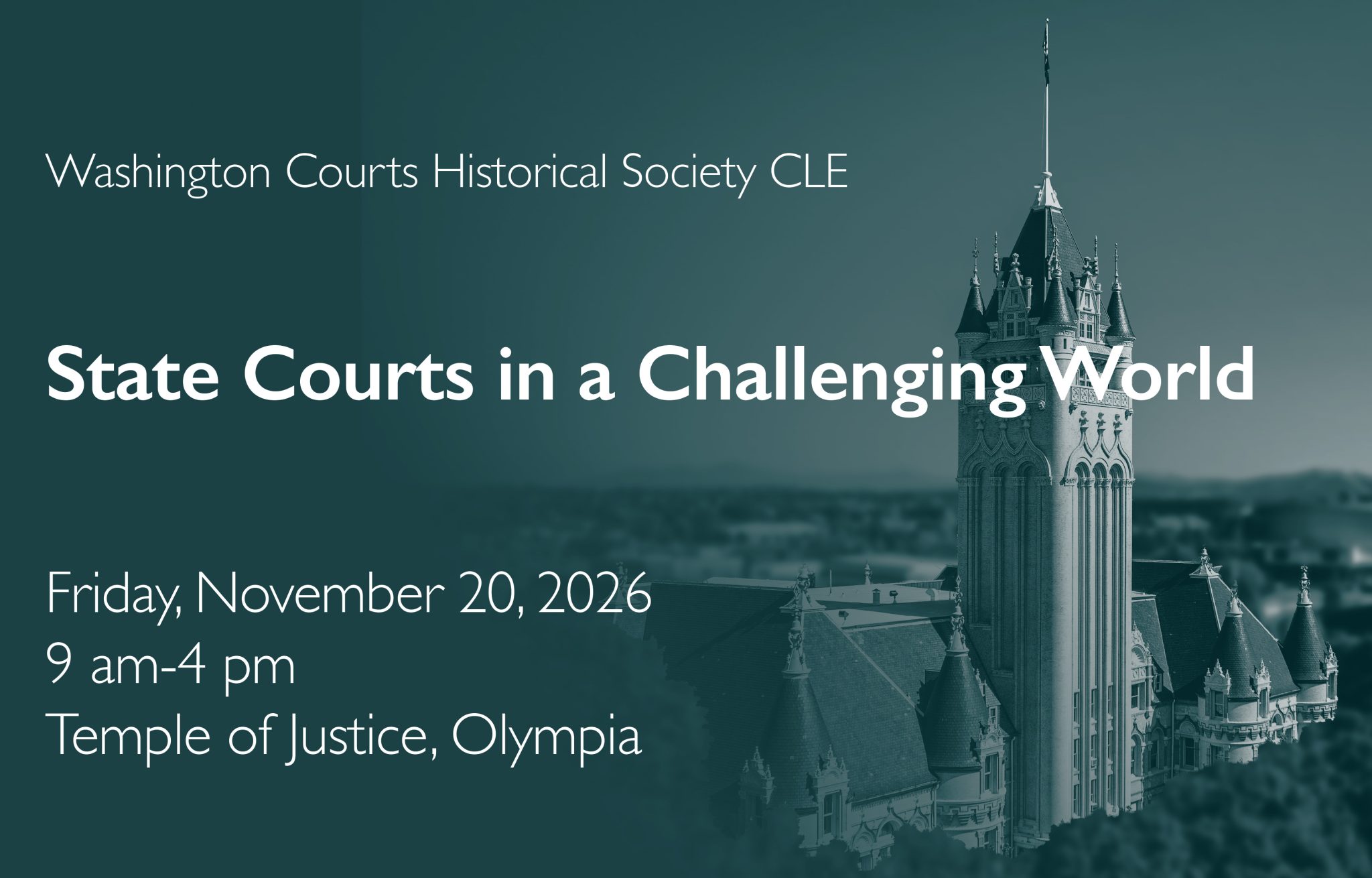
State Courts In a Challenging World CLE
Friday, November 20, 2026
9 am-4 pm
Temple of Justice, Olympia
The Washington Courts Historical Society will present its 2026 continuing legal education program, Courts Under Pressure, on Friday, November 20, 2026, at the Temple of Justice in Olympia. The daylong event will bring together judges, lawyers and scholars for timely conversations about the pressures facing state courts and the legal profession.
With public attention increasingly focused on courts, elections, speech, and technology, this year’s program will examine how Washington’s judicial system has responded to challenge and change over time—and how it may continue to adapt in the years ahead. 5.25 CLE credits, including 1 ethics credit, have been requested.
The program will open with remarks by Chief Justice Stephens. The morning sessions will begin with a panel discussions on the limits of judicial and lawyer speech, partisanship in Washington judicial elections and courts, elections, politics, and controversy, and will conclude with a one-hour panel on artificial intelligence and historical research.
The CLE is designed for members of the bench and bar, legal historians, and anyone interested in the role of state courts in a period of public, political, and technological change. Box lunches may be ordered at registration.
To register, visit the program’s website here.
Interested more information about Washington State legal history? Since its founding more than 20 years ago under the leadership of Justices Gerry Alexander, Charles Wiggins and Phil Talmadge, the Society has become the state’s principal nonprofit organization dedicated to the evolution of Washington’s courts, judges, attorneys, and legal institutions while fostering greater public understanding of the rule of law.
The Society’s work centers on collecting, preserving, and disseminating written and oral histories, archival materials, artifacts, photographs, memorabilia, and other resources relating to the state’s judicial system and legal profession.
Among its principal activities are:
Unlike state agencies, the Society receives no direct state funding. Its work depends on private donations, grants, and the dedication of volunteers who share a commitment to preserving Washington’s legacy.
You can join or obtain more information by visiting the Society’s website. (Washington Courts Historical Society)